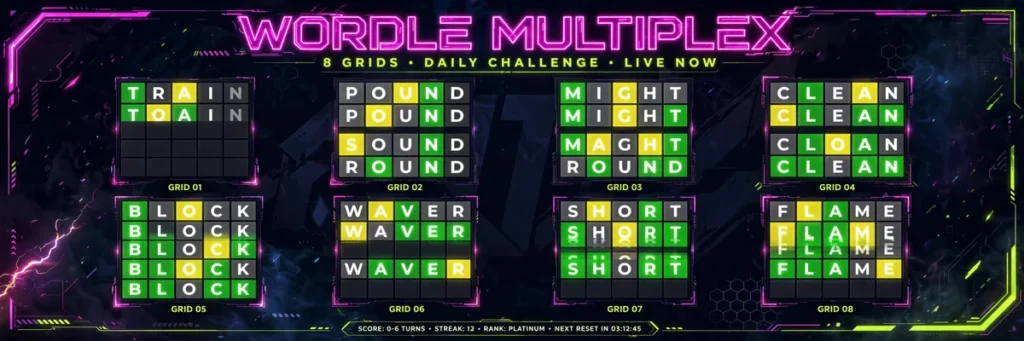
If four grids sounded fun, here is the bigger beast. This how to play octordle guide walks you through eight grids, thirteen shared guesses, and the calmer mindset you need to clear them all without running out of room.
Octordle is the natural big sibling of Quordle. The rules will feel familiar, but the strategy shifts in important ways because thirteen guesses across eight grids is a tighter budget than it looks. Read this before your first game and you will skip the painful learning curve most new players suffer through.
How to Play Octordle: The Core Rules
Octordle shows eight five letter grids at once. You get thirteen guesses total, and each guess is entered into every unsolved grid simultaneously, exactly like Quordle. The color feedback is the same system you know: green for correct letter and position, yellow for correct letter in the wrong position, gray for letters not in that word.
Each grid scores its word independently, so one guess produces eight different feedback patterns. Solved grids lock and your remaining guesses concentrate on the grids still open. You win by solving all eight words within thirteen guesses, which demands far more discipline than the daily Wordle ever will.
Let us picture the opening. You play CRANE and eight feedback patterns bloom at once. Two grids show a green A, three show a yellow R, the rest are mostly gray with a stray yellow each. Already you can see the shape of the game: some grids are giving you plenty to work with, others are staying mysterious, and your next guess has to serve all of them.
Free Mode, Rescue Mode and Other Ways to Play
The daily Octordle gives everyone the same eight words, one shot per day. It is the mode that counts for streaks and bragging rights, so save your sharpest focus for it.
Free mode offers unlimited puzzles with no stakes. This is where you should live while learning, because Octordle strategy is unintuitive and only repetition makes it natural. Play ten free games before judging whether the format clicks for you.
Some versions of the octordle game include extra twists. A rescue option can grant bonus guesses when you are stuck, which is perfect for learning the endgame without the pressure of a hard thirteen guess cap. You may also find a sequence mode where you solve grids one at a time with individual guess limits, a gentler on ramp for true beginners.
How Octordle Strategy Differs From Quordle
The biggest difference is the scouting phase. In Quordle you can cover ten fresh letters in two guesses and start solving. In Octordle, eight grids need more information before solving becomes efficient, so strong players spend three full guesses scouting before committing to any single grid.
The per grid budget is also tighter. Thirteen guesses across eight grids means less than two guesses per grid if you split evenly, which you should never do. The winning approach is lopsided by design: cheap grids fall fast, and the savings fund the two or three genuinely hard grids.
Attention management matters more here. With eight boards, tunnel vision is the default failure mode. Build a habit of scanning all eight grids before every single guess, even when you feel sure about your next move. The grid you are ignoring is usually the one that kills the run.
Opener Sets That Cover the Alphabet
Your first three guesses should be a scouting trio with fifteen unique letters. A reliable core is CRANE followed by SPOIL, which together test ten of the most valuable letters in the game: C, R, A, N, E, S, P, O, I and L.
For guess three, build a word from the most common remaining letters: D, G, H, M, Y, B, F and W. Something like FUDGY tests F, U, D, G and Y in one shot. It does not need to be elegant. It needs to be fresh, because every new letter you test pays out across eight grids at once.
After the trio, look at what the boards are telling you. If several grids already show two or three greens, you can start solving. If most grids are still thin on information, one more scouting guess with the remaining common letters is acceptable, but four is the absolute limit. Beyond that you are stealing from your endgame.
Managing Eight Grids Without Losing Track
Give every grid a quick mental label after the scouting phase: easy, medium or trap. Easy grids have two or more greens. Medium grids have useful yellows but no clear shape yet. Trap grids show patterns with many possible answers, like _OUND or _IGHT, where guessing blind is expensive.
Solve in that order. Easy grids first, because they cost almost nothing and each solved grid simplifies your remaining decisions. Medium grids next, using the information your easy grid solves generated along the way. Trap grids last, when you have maximum information and can afford to spend two careful guesses instead of gambling.
Keep one anchor grid in mind at all times: the grid closest to solved. When you are unsure what to play, make a guess that finishes the anchor grid while testing something useful elsewhere. This keeps every guess productive even when the board feels chaotic.
Mistakes That End Octordle Runs
- Opening with a single word. One scouting guess across eight grids is nowhere near enough information. Commit to the trio.
- Solving left to right. Grid order means nothing. Solve by clarity, not by position on screen.
- Ignoring a grid until guess ten. The forgotten grid always turns out to be the trap. Scan all eight every turn.
- Repeating gray letters. With thirteen guesses, every slot is precious. Dead letters stay dead.
- Guessing into trap patterns. If a grid could be six different words, do not guess any of them yet. Gather more letters first.
- Panicking at guess eleven. Rushing produces sloppy guesses. Slow down, recount your remaining budget, and play the percentages.
Six Tips for Clearing All Eight
- Memorize your trio. CRANE, SPOIL, FUDGY should be muscle memory. Thinking about openers wastes mental energy you need for eight boards.
- Count down from thirteen. After guess nine, say the remaining number out loud. Awareness of the budget prevents the classic guess twelve disaster.
- Bank the easy grids early. Three grids with two greens each can often be closed in two total guesses if you sequence them well.
- Starve the trap grids. Give a _IGHT grid zero dedicated guesses until you have spare budget. Information from other grids often resolves it for free.
- Use yellows as elimination. A yellow letter rules out every position it has been tried in. Track this mentally to shrink trap patterns fast.
- Finish with a cushion. Aim to have at most two unsolved grids entering guess twelve. Guess thirteen should never be a coin flip.
The Bottom Line
Octordle looks intimidating, but it is just Quordle with the volume turned up. Scout with three fresh words, solve your clearest grids first, starve the traps, and guard your thirteen guess budget like it matters, because it does. Ten practice games with this routine and the eight grid clear will feel earned instead of lucky.
When you are done, warm up with our free Wordle solver before your next run.