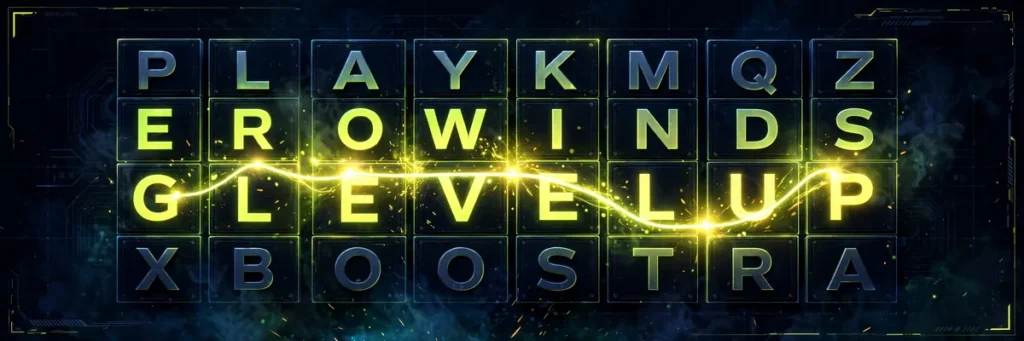
Strands takes the classic word search you did with a pencil as a kid and turns it into a daily battle of wits. You get a grid packed with letters and a short theme clue, and somewhere in that jumble hide several theme words plus one special showpiece called the spangram. Learning how to play Strands is mostly about learning how to think like the puzzle: every letter gets used, nothing is wasted, and the spangram is always the key that unlocks the board.
All examples below are invented for teaching. Nothing here comes from a real daily puzzle, so your future solves stay spoiler free.
What Is Strands?
Strands is a daily word search puzzle from the New York Times. You see a grid of letters, six rows by eight columns, and a theme like “Breakfast Time.” Hidden in the grid are theme words that match the theme, and every single letter on the board belongs to exactly one word. There are no leftover letters and no unused corners. When you find every theme word, including the spangram, you win.
Unlike a paper word search, words in Strands can twist and turn. You drag your finger or mouse from letter to touching letter, and the path can bend in any direction as long as each step moves to a neighboring tile. Words can snake around, double back, and curl into shapes you would never expect.
The Spangram: The Star of the Show
Every Strands puzzle has one special word called the spangram. It describes the theme itself, it uses letters that stretch from one side of the board all the way to the opposite side, and finding it usually cracks the puzzle wide open. Think of it as the title of the puzzle written across the grid in letters.
Here is an invented example. Imagine the theme is “Breakfast Time” and the spangram is MORNING MEAL, snaking from the left edge to the right edge. Once you spot it, you instantly know the puzzle is about breakfast, and every remaining word must fit that idea. That is why experienced players hunt the spangram before anything else.
How Hints Work
Stuck? Strands lets you earn hints, and the system is generous. Find any three valid English words of four or more letters that are not theme words, and you bank one hint. Tap the hint button and the game lights up the letters of a theme word you have not found yet, in order, so you can trace them yourself.
A few things to know about hints. They never expire, you can earn as many as you like, and using one does not end your game. Some players save hints for the very end when one stubborn word refuses to appear. Others spend a hint early to confirm they are reading the theme correctly. Both approaches are fine.
How to Play Strands Step by Step
Step 1: Read the theme. The theme is your compass. Say it out loud and brainstorm the kinds of words that fit. If the theme is about breakfast, your brain should already be listing eggs, toast, and pancakes before you touch the grid.
Step 2: Scan the edges for the spangram. Because the spangram must touch two opposite sides, start by looking along the borders. Long words that stretch across the board are often the spangram announcing itself.
Step 3: Drag to form words. Touch a starting letter and drag through neighboring letters. If the path spells a theme word, it locks in with a blue highlight. If it spells a valid but non theme word, it counts toward your next hint.
Step 4: Use every letter. Remember that each letter belongs to exactly one word. If a corner of the board is still untouched late in the game, the missing word almost certainly lives there. Work the lonely areas.
Step 5: Spend hints wisely. When only one or two words remain and the board feels picked clean, cash in a hint. The revealed letters usually make the answer obvious.
Common Beginner Mistakes
New players tend to fight the puzzle instead of flowing with it. These are the traps to avoid.
Ignoring the Spangram
Many beginners treat the spangram like just another word. It is not. It describes the whole theme, so finding it first gives you the master key for everything else. Always prioritize it.
Searching Only in Straight Lines
Paper word searches trained us to look horizontally and vertically. Strands words bend, zigzag, and spiral. If you only scan in straight lines, you will miss most of the board. Practice following winding paths with your eyes.
Wasting Hints on Easy Words
Spending a hint when three theme words are already obvious is like using a map in your own neighborhood. Save hints for the endgame, when the remaining letters form a confusing knot.
Forgetting That Every Letter Is Used
This is the most powerful rule in the game and the most ignored. Every letter belongs to something. If you have twelve untouched letters clustered together, stop hunting randomly and focus on that cluster. The word is hiding in plain sight.
How to Play Strands Like a Winner: 7 Tactics
Put these into practice and your solve times will drop quickly.
- Chase the spangram first. Scan the left and right edges, then top and bottom, for a long winding word. Nailing the spangram early often solves half the puzzle mentally.
- Farm hints with common words. Short everyday words like CARE, NOTE, and PLANT appear in many grids. Finding three of them banks a free hint, so keep a mental list of flexible four letter words.
- Clear the corners. Corner letters have fewer neighbors, which means fewer possible paths. Words hiding in corners are easier to trace, so clear them early to simplify the board.
- Look for familiar chunks. Common beginnings like RE, UN, and PRE, and endings like ING, ED, and ER, jump out of letter jumbles. Spot a chunk and build outward from it.
- Say the theme as a question. Turn “Breakfast Time” into “what do people eat for breakfast?” Your brain retrieves answers faster when the theme becomes a question.
- Trace with your finger, even on desktop. Physically following a path, whether on a touchscreen or with a mouse, helps you see bends your eyes skip over. Movement reveals patterns.
- Use the hint on the longest word. When you finally spend a hint, the game helps with a word you have not found. Long words are harder to spot, so hints pay off most when the remaining words look long and tangled.
Quick Answers for New Players
Do I have to find the spangram to win? Yes, the spangram counts as one of the theme words, so the puzzle is not complete without it. The good news is that it is usually the most satisfying find of the day.
Can I play without ever using hints? Absolutely. Hints are optional, and many players treat a hint free solve as a personal badge of honor.
How long does a puzzle take? Most players finish in five to fifteen minutes. Once you understand how to play Strands well, the spangram often appears within the first minute.
Read the theme, hunt the spangram along the edges, and remember that no letter is ever wasted. Do that consistently and Strands will start feeling less like a search and more like a conversation with the puzzle maker.