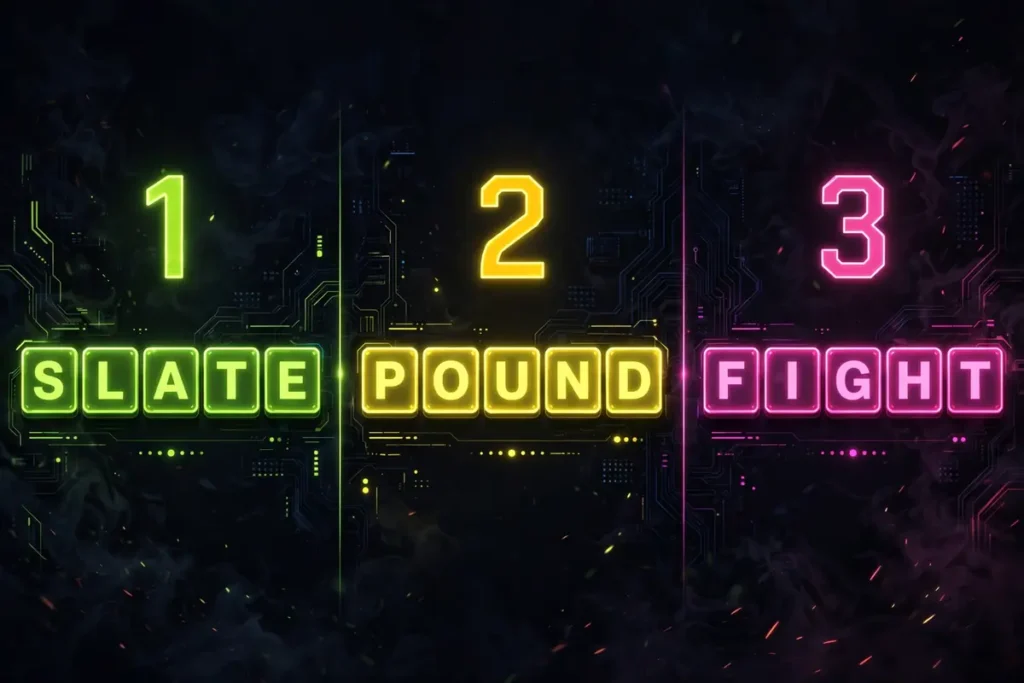
Wordle Strategies That Actually Work
You have six guesses. The answer is one five letter word. That sounds simple, but anyone who has stared at four gray tiles on guess five knows the panic. Most wordle strategies you find online are just loose tips. Use a vowel heavy opener. Do not repeat letters. Take your time. Good advice, but it is not a plan. What follows is a plan. It is called the 3 phase method, and it gives every guess a clear job: Probe, Position, Close. Follow it daily and your win rate will climb.
Why Most Wordle Tips Fail
Tips fail because they do not tell you what to do next. Knowing that E is common does not help you on guess three when you have two yellows and no greens. A tip is a fact. A strategy is a sequence. The difference matters most when the puzzle gets hard, around guess four, when one wrong move ends your streak. Random guessing feels active, but it wastes the most valuable thing you have: information from earlier guesses. The 3 phase method fixes this by making each guess earn its place.
Think of it like this. Early guesses gather letters. Middle guesses lock positions. Late guesses finish the job. When every guess has a role, you stop panicking and start solving.
The 3 Phase Method: Your New Wordle Strategy
Here is the full system in one paragraph. Phase 1, Probe, means testing fresh letters to find which ones are in the answer. Phase 2, Position, means using yellow and green tiles to pin those letters into exact spots. Phase 3, Close, means listing every word that still fits and picking the smartest final guess. Three phases, six guesses, one calm path to the answer. This wordle strategy works because it matches how information actually builds during a game.
You do not need a huge vocabulary. You need discipline. Ask yourself which phase you are in, then choose a guess that does that phase’s job.
Phase 1: Probe
Every gray tile crosses letters off your list. Every yellow or green tile gives you a confirmed letter to build on.
What Makes a Good Probe
A good probe uses five different common letters. Include two or three vowels, plus frequent consonants like R, S, T, L, and N. Words like ADIEU, SLATE, CRANE, and ROAST are popular openers for this reason. Pick one you like and use it every day.
When to Stop Probing
Stop probing when you have three or more confirmed letters, or when you have tested ten unique letters. Most games need only one or two probes. If your first guess gives you all grays, take a second probe with five brand new letters. Do not probe a third time. Guesses are precious, and Phase 2 needs room to work.
Phase 2: Position
Now comes positional play. You know some letters are in the word. The question is where they sit. A yellow tile says the letter is in the answer but in the wrong spot. A green tile says you nailed it. Phase 2 guesses should test new positions for your yellow letters while trying fresh letters in the empty spots.
Reading Your Tiles
After each guess, sort what you know into three piles. Confirmed letters, with greens locked in place. Yellow letters, which must move to a new slot. Dead letters, the grays you will never use again. Write the pattern down if it helps. Something like _ R A _ _ tells your brain exactly what to hunt for. This small habit raises guess efficiency more than any clever opener.
Building the Pattern
Look for common letter pairs. T H, C H, S H, and S T cluster together. If you have R and A confirmed, think about where they like to appear, like R A in BRAND or A R in HEARD. Your Phase 2 guess should test one strong pattern while checking a new letter or two. You are not trying to win yet. You are trying to turn yellows green.
Phase 3: Close
Do not guess the first word that pops into your head. Slow down. List every candidate. Then choose.
The Candidate List Trick
Before your next guess, say out loud every word that fits your pattern. If the pattern is _ I G H T and your dead letters rule out L, F, and E, the list shrinks to NIGHT, RIGHT, SIGHT, and TIGHT. Saying them aloud stops your brain from locking onto one option. If you get stuck and the list feels empty, a word solver tool can help you brainstorm candidates that fit the pattern.
Safe Play vs the Bold Shot
When you have two or more guesses left, stay safe. Pick a guess that separates your candidates by testing their differing letters. When you are down to your last guess, commit to the candidate that fits best. Hesitation has ended more streaks than bad luck.
Full Game Walkthrough: The Method in Action
Here is a complete game, played with the 3 phase method from the first guess to the win. Notice how each guess does its phase’s job.
Guess 1: ADIEU (Probe)
We open with ADIEU to test four vowels at once. The result: A turns yellow, D, I, E, and U turn gray. A is in the word, but not in position one. Four vowels eliminated in one guess.
Guess 2: SPORT (Probe)
We still need consonants, so we probe five fresh ones: S, P, O, R, T. The result: R turns yellow, the rest go gray. Now we have two confirmed letters, A and R, and eight dead letters. Probing is done. Time to position.
Guess 3: BRAND (Position)
We need to place A and R while testing new letters B, N, and D. BRAND does all of that. The result: R turns green in position two, A turns green in position three. B, N, and D go gray. The pattern is now _ R A _ _. Two letters locked. This is positional play paying off.
Guess 4: CRACK (Close)
Time to list candidates. The pattern is _ R A _ _. Dead letters include D, E, I, O, U, S, P, T, B, and N. What fits? CRACK and FRACK. CRACK is the more common word, so we play it. All five tiles turn green. Game won in four guesses.
No panic guesses. No repeated dead letters. Every guess had a job, and the jobs stacked into a win.
Advanced Wordle Strategy: Hard Mode and Streak Protection
Once the method feels natural, try hard mode. In hard mode the game forces you to reuse every confirmed letter in later guesses. This sounds scary, but the 3 phase method already plays that way. Phases 2 and 3 always build on confirmed letters, so hard mode changes almost nothing for you. It mainly stops lazy random guesses, which you have already quit.
Streak protection is about the danger zone: guesses five and six with multiple candidates left. Never guess blind into a crowd. The real skill is avoiding that spot. Use Phase 3 safety guesses early so you never face a coin flip on guess six.
Five Mistakes That Break Streaks
Even good players slip. Watch for these.
- Repeating gray letters. If a letter went gray, it is dead. Do not play it again unless you are testing a double letter on purpose.
- Ignoring yellow clues. A yellow letter must move. Guessing it in the same spot wastes a turn.
- Skipping the candidate list. Guessing the first word you think of in Phase 3 is how streaks die. List them all first.
- Probing too long. Three probes leave no room to solve. Two is the max in almost every game.
- Playing too fast. Speed adds nothing. Thirty extra seconds of thought beats a rushed guess every time.
Frequently Asked Questions
What is the best first guess in Wordle?
There is no single perfect opener, but the best ones test common letters fast. Words like SLATE, CRANE, ADIEU, and ROAST each check five frequent letters with no repeats. Pick one and use it daily.
Should I play Wordle in hard mode?
Yes, once you know the 3 phase method. Hard mode forces you to reuse confirmed letters, which is what Phases 2 and 3 do anyway. It makes the game more satisfying and your streaks more meaningful, without changing your approach.
How many guesses does the 3 phase method usually take?
Most games end in four or five guesses. Phase 1 takes one or two, Phase 2 takes one or two, and Phase 3 finishes it. Lucky probes can win in three. The method also survives six guess escapes.
What should I do with one guess left and several possible answers?
This is the toughest spot in Wordle. First, list every candidate carefully. Often one of them uses a letter you already ruled out, which shrinks the list. If several truly remain, pick the one that fits your reads best and commit.
Do these wordle tips and strategies work for other word games?
The core ideas transfer well. Letter elimination and positional play help in any guessing game with tile feedback. The phase structure also works for longer words if you adjust your probe picks. Only the exact opener lists are Wordle specific.
Conclusion
Most wordle strategies give you tips. This one gives you a system. Probe for letters, position them with care, then close with a full candidate list. Play the 3 phase method for a week and watch your average drop and your streak grow. The panic on guess five fades when every guess has a job. Now go start your next game with a plan.